 3 K! P( B3 a/ {) j9 l/ Q' E
[color=rgba(0, 0, 0, 0.749019607843137)]#一、国家名词整理[color=rgba(0, 0, 0, 0.749019607843137)]data<-read_csv('confirmed.csv')[color=rgba(0, 0, 0, 0.749019607843137)]data[data$`Country/Region`=='US',]$`Country/Region`='United States'[color=rgba(0, 0, 0, 0.749019607843137)]data[data$`Country/Region`=='Korea, South',]$`Country/Region`='Korea'[color=rgba(0, 0, 0, 0.749019607843137)]! w2 g9 Q/ J; t) k Z8 l
[color=rgba(0, 0, 0, 0.749019607843137)]information_data<-data[,1:4] #取出国家信息相关数据[color=rgba(0, 0, 0, 0.749019607843137)]inspect_data<-data[,-c(1:4)] #取出确诊人数相关数据[color=rgba(0, 0, 0, 0.749019607843137)]* h: a' G# L9 v& Q, E. e9 o+ R
[color=rgba(0, 0, 0, 0.749019607843137)]#二、日期转换[color=rgba(0, 0, 0, 0.749019607843137)]datetime<-colnames(inspect_data)[color=rgba(0, 0, 0, 0.749019607843137)]pastetime<-function(x){[color=rgba(0, 0, 0, 0.749019607843137)] date<-paste0(x,'20')[color=rgba(0, 0, 0, 0.749019607843137)] return(date)[color=rgba(0, 0, 0, 0.749019607843137)]}[color=rgba(0, 0, 0, 0.749019607843137)]datetime1<-as.Date(sapply(datetime,pastetime),format='%m/%d/%Y')[color=rgba(0, 0, 0, 0.749019607843137)]colnames(inspect_data)<-datetime1[color=rgba(0, 0, 0, 0.749019607843137)]
[color=rgba(0, 0, 0, 0.749019607843137)]#合并数据,data为累计确诊人数数据(预处理后)[color=rgba(0, 0, 0, 0.749019607843137)]data<-cbind(information_data,inspect_data)[color=rgba(0, 0, 0, 0.749019607843137)]二、新增确诊病例变化趋势#由累计确诊病例计算新增确诊病例
inspect_lag_data<-cbind(0,inspect_data[,1
 ncol(inspect_data)-1)])
increase_data<-inspect_data-inspect_lag_data
/ W% v9 t. l" B9 F% h4 p! {( d
#合并数据,new_data为新增确诊人数数据
new_data<-cbind(information_data,increase_data)
1. 中国新增确诊病例变化趋势
#合并所有省份新增确诊人数7 [) \* z+ a) B
china<-new_data[new_data$`Country/Region`=='China',]
china_increase<-data.frame(apply(china[,-c(1:4)],2,sum))
colnames(china_increase)<-'increase_patient'
china_increase$date<-as.Date(rownames(china_increase),format="%Y-%m-%d")
ggplot(china_increase,aes(x=date,y=increase_patient,color='新增确诊人数'))+geom_line(size=1)+
scale_x_date(date_breaks = "14 days")+ #设置横轴日期间隔为14天(注意:此时的date列必须为日期格式!)
labs(x='日期',y='新增确诊人数',title='2020年1月22日-2020年12月7日中国新增确诊人数变化趋势图')+
theme_economist()+ #使用经济学人绘图样(式ggthemes包)# S5 l$ g5 z% ?+ z
theme(plot.title = element_text(face="plain",size=15,hjust=0.5),* v7 z! u* r) N) M
axis.title.x = element_blank(),; Y0 l/ N4 U/ H8 {& L
axis.title.y = element_text(size=15),
axis.text.x = element_text(angle = 90,size=15),+ D2 G _: N$ ?1 w( c8 O
axis.text.y = element_text(size=15),
legend.title=element_blank(),3 e% a- Q8 Y0 q( K3 v# `
legend.text=element_text(size=15))+ D2 E3 O6 t7 ?

2. 美国新增病例变化趋势3 j, m) j: _3 U
us<-new_data[new_data$`Country/Region`=='United States',]
us_increase<-gather(us,key="date",value="increase_patient",'2020-01-22':'2020-12-07')
us_increase$date<-as.Date(us_increase$date)
ggplot(us_increase,aes(x=date,y=increase_patient,color='新增确诊人数'))+geom_line(size=1)+
scale_x_date(date_breaks = "14 days")+ #设置横轴日期间隔为14天8 X$ x1 e4 N7 P V0 G, O0 p/ e% v
labs(x='日期',y='新增确诊人数',title='2020年1月22日-2020年12月7日美国新增确诊人数变化趋势图')+2 S( a5 m7 `6 J$ W/ v4 }
theme_economist()+ #使用经济学人绘图样(式ggthemes包)& `8 @, h3 `0 m9 K& {. o& Z9 w7 L
theme(plot.title = element_text(face="plain",size=15,hjust=0.5),
axis.title.x = element_blank(),
axis.title.y = element_text(size=15),3 a$ g9 S0 W; j7 N; a
axis.text.x = element_text(angle = 90,size=15),4 K [ L7 ?. R! Y2 I
axis.text.y = element_text(size=15),3 M7 y% t! k& p6 {7 h
legend.title=element_blank(),- ~9 B f2 v9 f+ I! @) d" }2 X; h- q
legend.text=element_text(size=15))7 K$ S, [ X$ p, z4 F
& _3 C3 @& B w4 _9 n

3. 全球新增病例变化趋势
total_increase<-data.frame(apply(new_data[,-c(1:4)],2,sum))* b5 T+ S4 F0 B
colnames(total_increase)<-'increase_patient'8 w8 y9 l1 z8 |2 {- @
total_increase$date<-as.Date(rownames(total_increase),format="%Y-%m-%d")( ] v2 a5 V0 g3 E
ggplot(total_increase,aes(x=date,y=increase_patient,color='新增确诊人数'))+geom_line(size=1)+/ S4 W0 r: `* m+ u. o& ]
scale_x_date(date_breaks = "14 days")+
labs(x='日期',y='新增确诊人数',title='2020年1月22日-2020年12月7日全球新增确诊人数变化趋势图')+
theme_economist()+
scale_y_continuous(limits=c(0,8*10^5), #考虑数字过大,以文本形式标注y轴标签( O+ n. e1 M/ o( j
breaks=c(0,2*10^5,4*10^5,6*10^5,8*10^5),
labels=c("0","20万","40万","60万","80万"))+) ~ e- ?4 o2 N% S0 F0 R
theme(plot.title = element_text(face="plain",size=15,hjust=0.5),
axis.title.x = element_blank(),
axis.title.y = element_text(size=15),
axis.text.x = element_text(angle = 90,size=15),$ c S% p9 }0 f* z# m) S
axis.text.y = element_text(size=15),
legend.title=element_blank(),
legend.text=element_text(size=15))
: f1 m8 U0 e0 _2 C* y
 ! D1 `- o0 F$ I
三、新增确诊病例全球地理分布
mapworld<-borders("world",colour = "gray50",fill="white") 6 q8 X& q6 W9 D
ggplot()+mapworld+ylim(-60,90)+
geom_point(aes(x=new_data$Long,y=new_data$Lat,size=new_data$`2020-01-22`),color="darkorange")+
scale_size(range=c(2,9))+labs(title="2020年1月22日全球新增确诊人数分布")+3 f, E- g5 ?9 C0 {
theme_grey(base_size = 15)+/ E7 p1 @" b) O% z* d
theme(plot.title=element_text(face="plain",size=15,hjust=0.5),
legend.title=element_blank())
ggplot()+mapworld+ylim(-60,90)++ ^: T+ v- |9 [) \' \) u
geom_point(aes(x=new_data$Long,y=new_data$Lat,size=new_data$`2020-11-22`),color="darkorange")+
scale_size(range=c(2,9))+labs(title="2020年11月22日全球新增确诊人数分布")+
theme_grey(base_size = 15)+% c# w8 c7 j% a' M
theme(plot.title=element_text(face="plain",size=15,hjust=0.5),
legend.title=element_blank())7 i2 w' Y5 B7 H


四、累计确诊病例动态变化图
1. 至12月7日全球累计病例确诊人数前十国家
0 N L7 E& O; X* i% ycum_patient<-data[c("Country/Region","2020-12-07")]
cum_patient<-cum_patient[order(cum_patient$`2020-12-07`,decreasing = TRUE),][1:10,]
colnames(cum_patient)<-c("country","count")
cum_patient<-mutate(cum_patient,country = fct_reorder(country, count))
cum_patient$labels<-paste0(as.character(round(cum_patient$count/10^4,0)),"万")
ggplot(cum_patient,aes(x=country,y=count))+
geom_bar(stat = "identity", width = 0.75,fill="#f68060")+
coord_flip()+ #横向
xlab("")+
geom_text(aes(label = labels, vjust = 0.5, hjust = -0.15))+
labs(title='至2020年12月7日累计确诊病例前十的国家')+
theme(plot.title = element_text(face="plain",size=15,hjust=0.5))+
scale_y_continuous(limits=c(0, 1.8*10^7))
 - q" n* B h0 A) n( o) o5 o
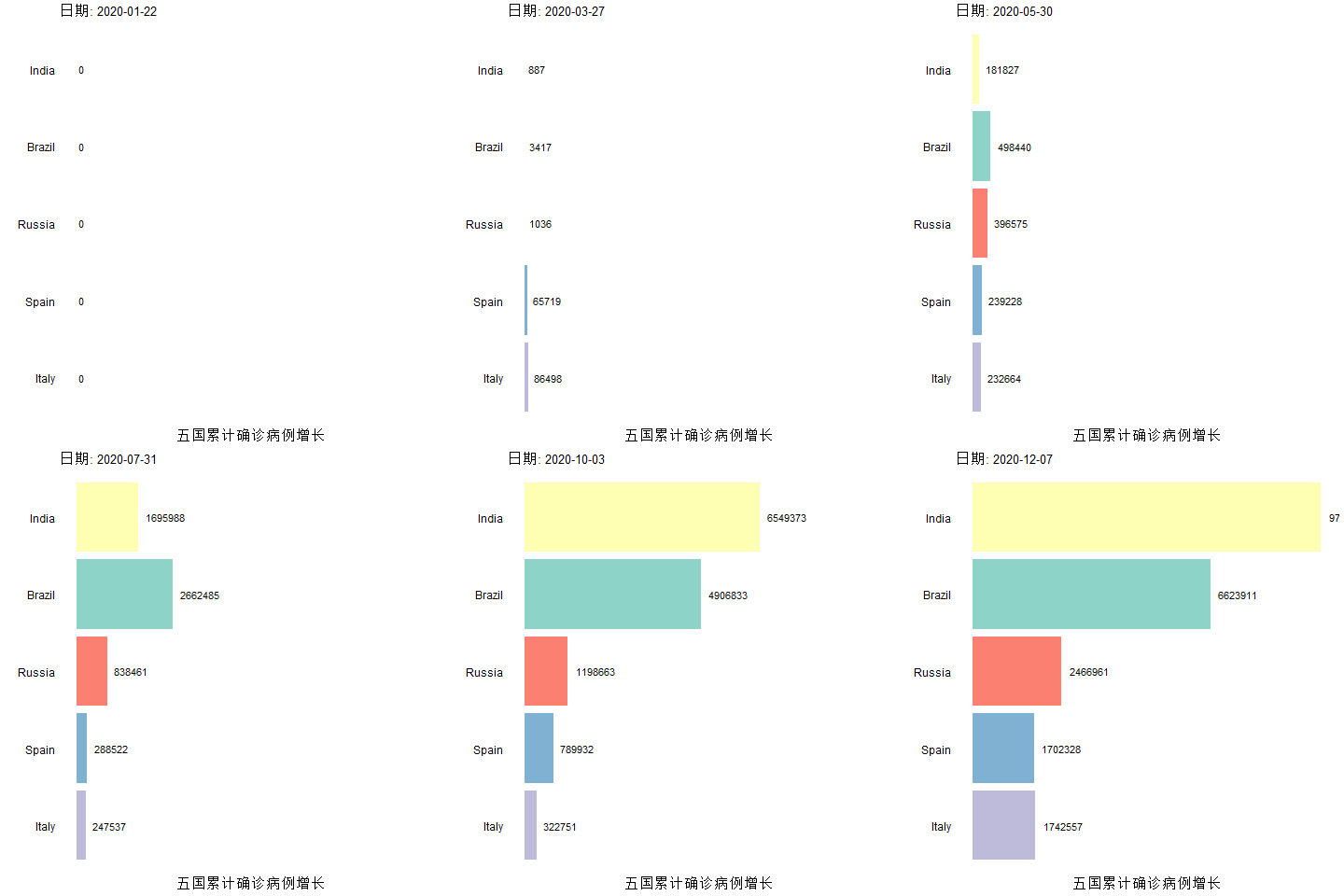
2. 五国(India、Brazil、Russia、Spain、Italy)累计确诊病例动态变化图% y3 y) U7 c3 X$ x! q, @' L5 d: R
cum_patient_time<-gather(data,key="date",value="increase_patient",'2020-01-22':'2020-12-07')7 z: d0 Y0 s, Z
colnames(cum_patient_time)<-c("
 rovince","Country","Lat","Long","date","increase_patient")
five_country<-subset(cum_patient_time,Country %in% c("India","Brazil","Russia","Spain","Italy"))6 o. a0 E8 d$ W4 J# G5 o
five_country$date<-as.Date(five_country$date)& V6 r, [. I5 Y* p/ |7 t2 b* p6 g
ggplot(five_country,
aes(x=reorder(Country,increase_patient),y=increase_patient, fill=Country,frame=date)) +
geom_bar(stat= 'identity', position = 'dodge',show.legend = FALSE) + ; y9 E: t; [: a, {5 k4 }
geom_text(aes(label=paste0(increase_patient)),col="black",hjust=-0.2)+
scale_fill_brewer(palette='Set3')+ #使用Set3色系模板
theme(legend.position="none",: t9 K+ @6 N% E% e" R
panel.background=element_rect(fill='transparent'),
axis.text.y=element_text(angle=0,colour="black",size=12,hjust=1)," ^$ Y6 [- [1 Z
panel.grid =element_blank(), #删除网格线
axis.text = element_blank(), #删除刻度标签
axis.ticks = element_blank(), #删除刻度线
)+
coord_flip()+ ( T, p- M7 A; v- r+ A
transition_manual(frames=date) + #动态呈现
labs(title = paste('日期:', '{current_frame}'),x = '', y ='五国累计确诊病例增长')+
theme(axis.title.x = element_text(size=15))+
ease_aes('linear')
anim_save(filename = "五国累计确诊病例增长动态图.gif")
* @7 e/ A: ]+ g( a% x* Q1 D
2 n1 |3 b& g! L